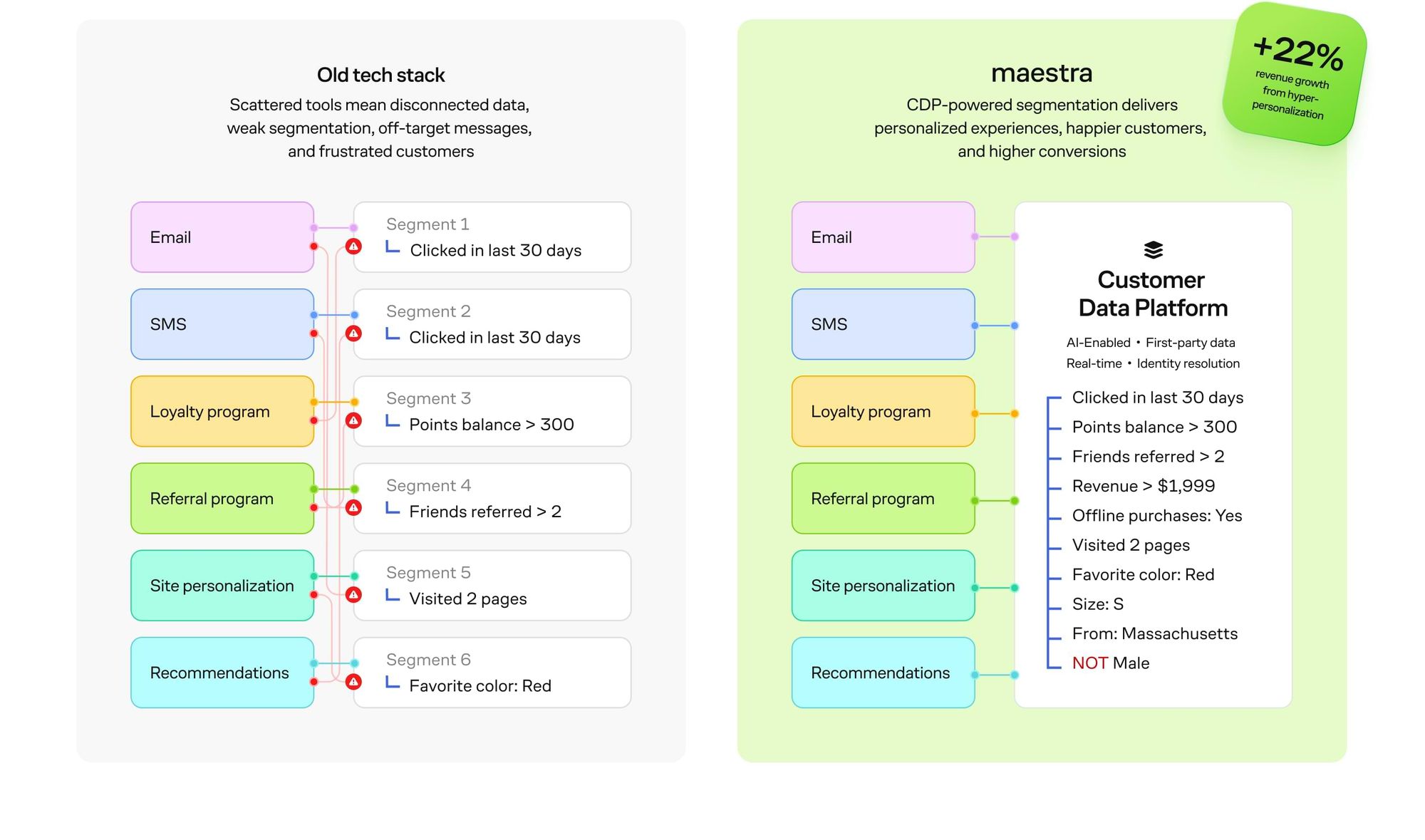
Siloed customer data, no single view
One system your whole team can look at and agree on
Maestra Platform is the all-in-one retention marketing platform for ecommerce brands, so reporting and sending come from the same place, with a forward-deployed marketer keeping it honest.
Brands running on Maestra






The problem
Online and offline never reconcile
Brands with retail locations, dealer networks, or multiple storefronts often can't connect in-store behavior to online activity. That gap blocks loyalty programs and abandoned-cart flows from working the way they should.
What we hear from brands
a regional furniture retailer: the disconnect between online and in-store data limits cohesive customer journeys
a national tool and hardware retailer: fragmented in-store and e-commerce data prevents a true omnichannel view
a national surf and streetwear chain: in-store and digital behaviors can't be bridged
The new way
Segmentation without the spreadsheet
Instead of manual list pulls, Maestra lets you segment by customer, product, brand, order status, or purchase history directly in the platform. Historical tracking, calculated fields, and nested logic replace the manual stitching altogether.
Outcomes brands report
Customer proof
The website changed because the profile told it what to change

Site content had no access to what the email program knew about a visitor. Once both read the same profile, the personalized version of the site earned nine percent more than the control group seeing the standard one.
 Read the full case study
9%
incremental revenue compared to the control group
How it works
Migration at any scale, same method
Map what exists
Every flow, segment, and integration currently running is inventoried before a single one is rebuilt.
Rebuild in parallel
Your marketer has moved brands of every size and runs the new setup next to the old one until it matches.
Go live in weeks
Two to four weeks is typical, three to seven for nine-figure complexity, with no gap in sending.
The platform
Built around orders, not around contacts
Generic marketing platforms treat a customer as a row with attributes. Here the model starts from carts, orders, and catalog, so questions about repeat purchase or category affinity are queries rather than projects.
Including
Your forward-deployed marketer
The difference between advice and implementation
An agency sends recommendations and an invoice. Your marketer opens the platform and builds the thing, which is why the improvements that are technically easy but always postponed actually ship.
Work delivered in the platform, not as a deck
The postponed improvements get shipped
No separate services fee
Replace your stack
Migrating off does not mean starting over
The programs you have been refining for years are rebuilt, not discarded, and the history comes with them, so the reporting still reaches back past the switch.
The next step is smaller than a migration
Look at the platform, ask what your first month would look like, and decide after that.